
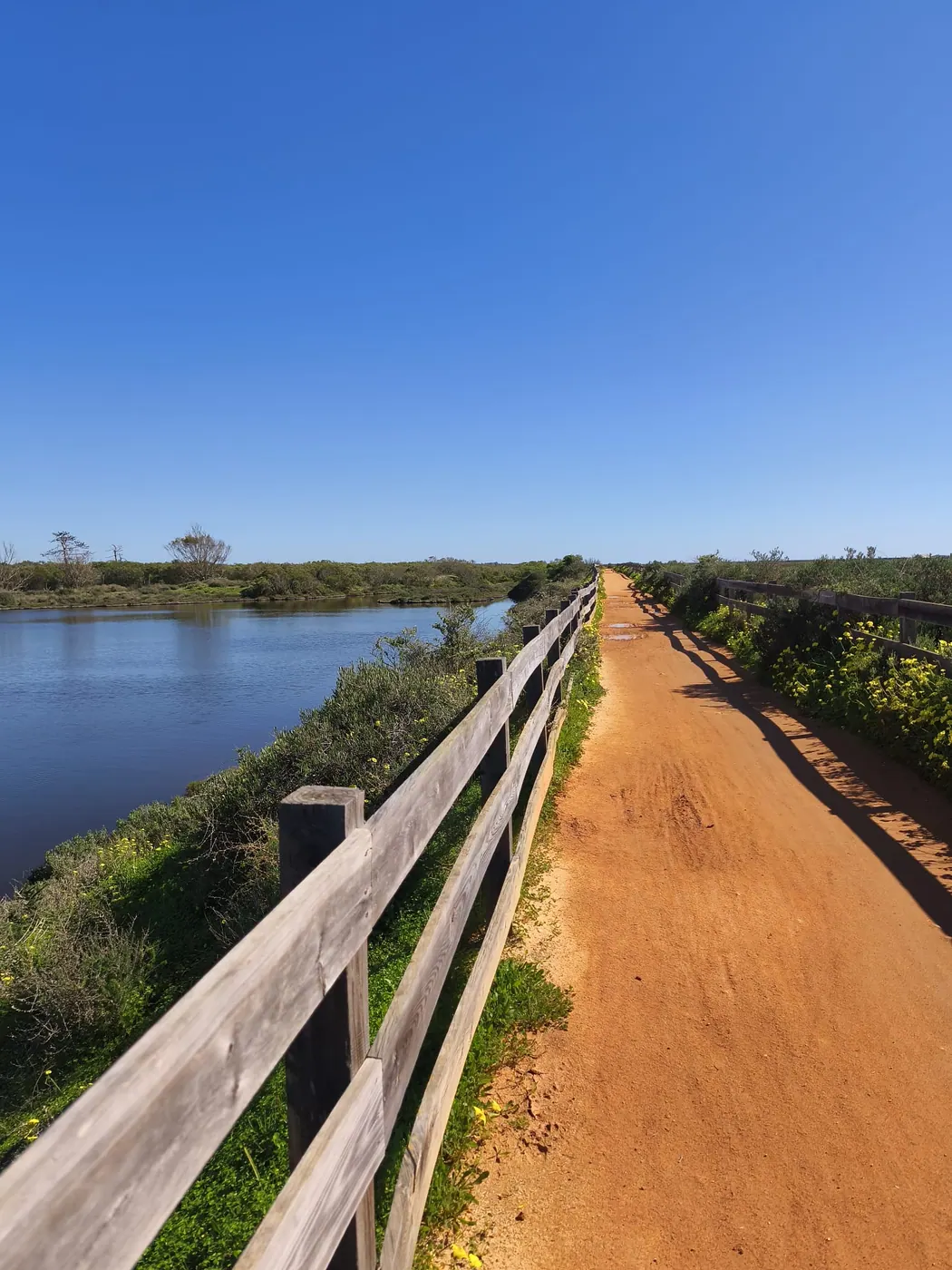
The Ludo Trail is a flat, easy walk through the Ria Formosa Natural Park, right next to Faro airport and about 10 minutes from the city. In one morning you pass salt pans, the edge of the lagoon, pine woods and two bird hides, and you can see flamingos, spoonbills, waders and the purple swamphen. The route I recommend is about 9 km there and back, combining the Ludo Trail with part of the São Lourenço trail, near Quinta do Lago. It is the same route we follow on our birdwatching walks.
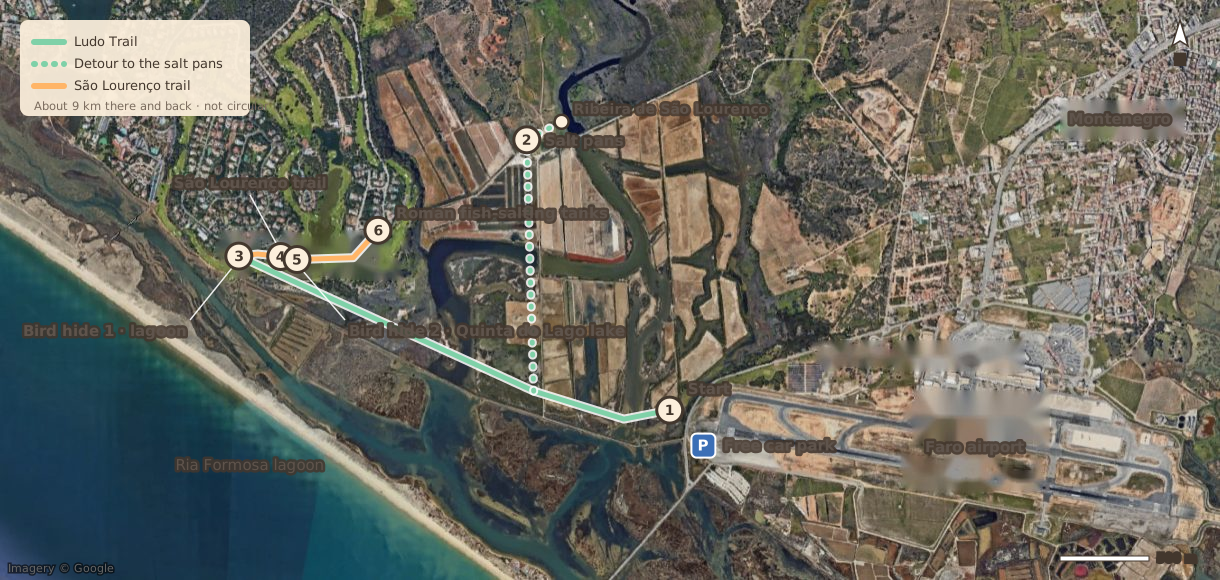
Route, distance and difficulty
- Distance: about 9 km, there and back.
- Time: 3 to 4 hours at a birdwatching pace, with stops.
- Difficulty: easy. Flat dirt paths, with little shade.
- Type: not circular. Parts of the area are closed to protect the birds, so you return the same way.
Step by step
- Start at the beginning of the Ludo Trail, near the airport.
- The salt pans. After about 1 km, turn right to visit the salt pans, a nesting and feeding area for a great variety of birds and other small animals. Walk to the end, at the São Lourenço stream (Ribeira de São Lourenço), then come back to the main trail.
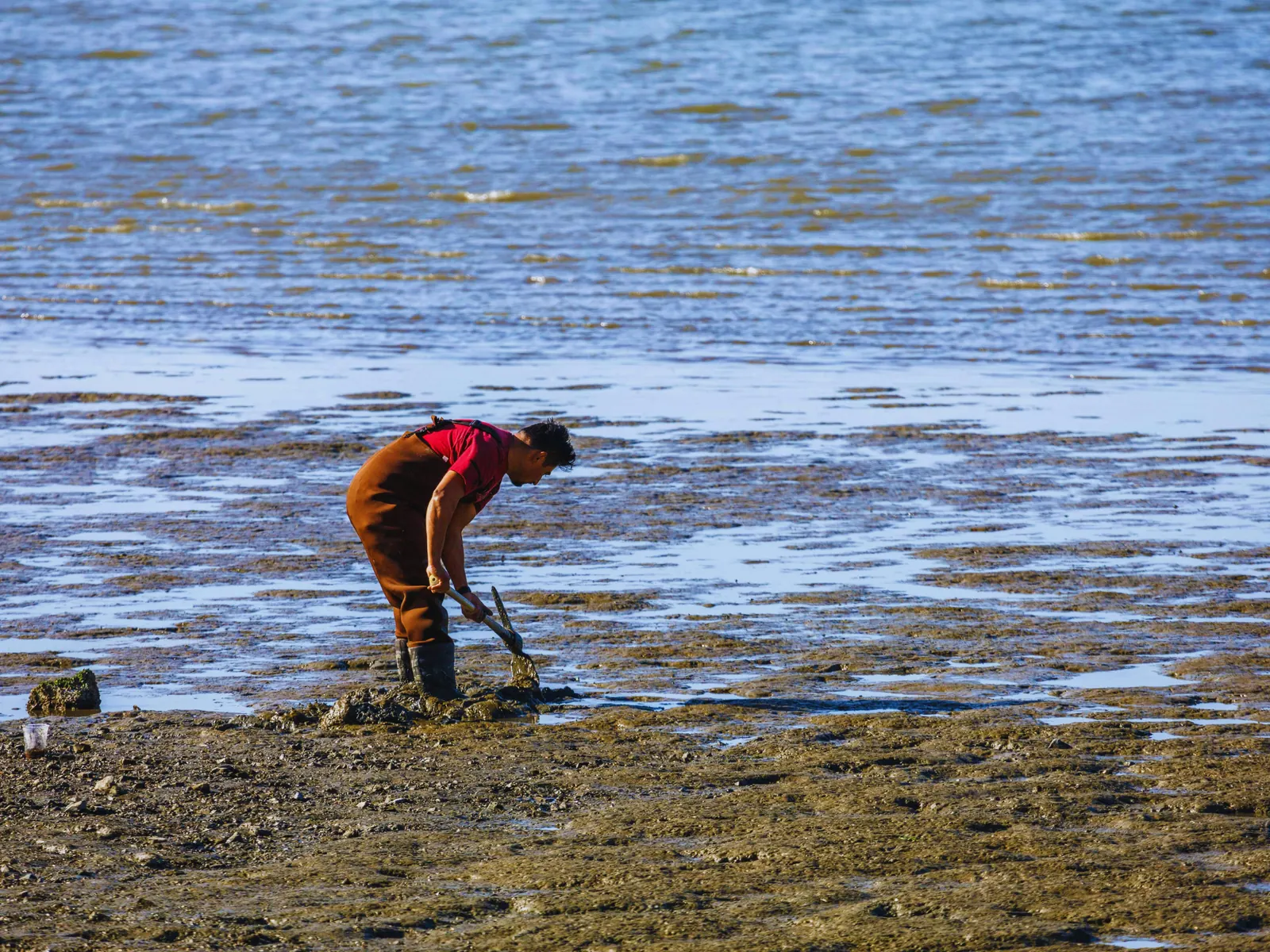
- The first bird hide, over the lagoon. Back on the Ludo Trail, turn right and head west. After about 1.5 km you reach the first hide, facing the open lagoon. Depending on the tide, you can watch many species of waders feeding, and the shellfish harvesters working the mudflats.
- Into the São Lourenço trail. Take the inland dirt path onto the São Lourenço trail. The vegetation changes completely, from salt marsh to pine wood and reeds.
- The second bird hide, over a freshwater lagoon. About 400 m further on, the second hide looks out over a small inland lagoon, one of the lakes of Quinta do Lago. The variety of birds here is huge, and most of them are different from the species on the lagoon side.
- The Roman fish-salting tanks. About 500 m ahead, on your right, are the ruins of fish-salting tanks built by the Romans.
- The way back. Return the same way. There is no need to go through the salt pans again.
Whenever you walk near the Quinta do Lago golf course, look at the grass: several species of birds come to feed there.
How to get there
- By car: there is a free car park on the south side of Faro airport, close to the start of the trail.
- By bus or taxi: bus line 16 to Praia de Faro stops at the roundabout with the crab sculpture, just before the beach, near the start of the trail. A taxi from Faro takes about 10 minutes.
- Our meeting point: our Birdwatching & Nature walk and our Sunset Walk start at that bus stop, at the crab sculpture roundabout.
What you will see
The Ludo is special because it brings several habitats together in a short distance:
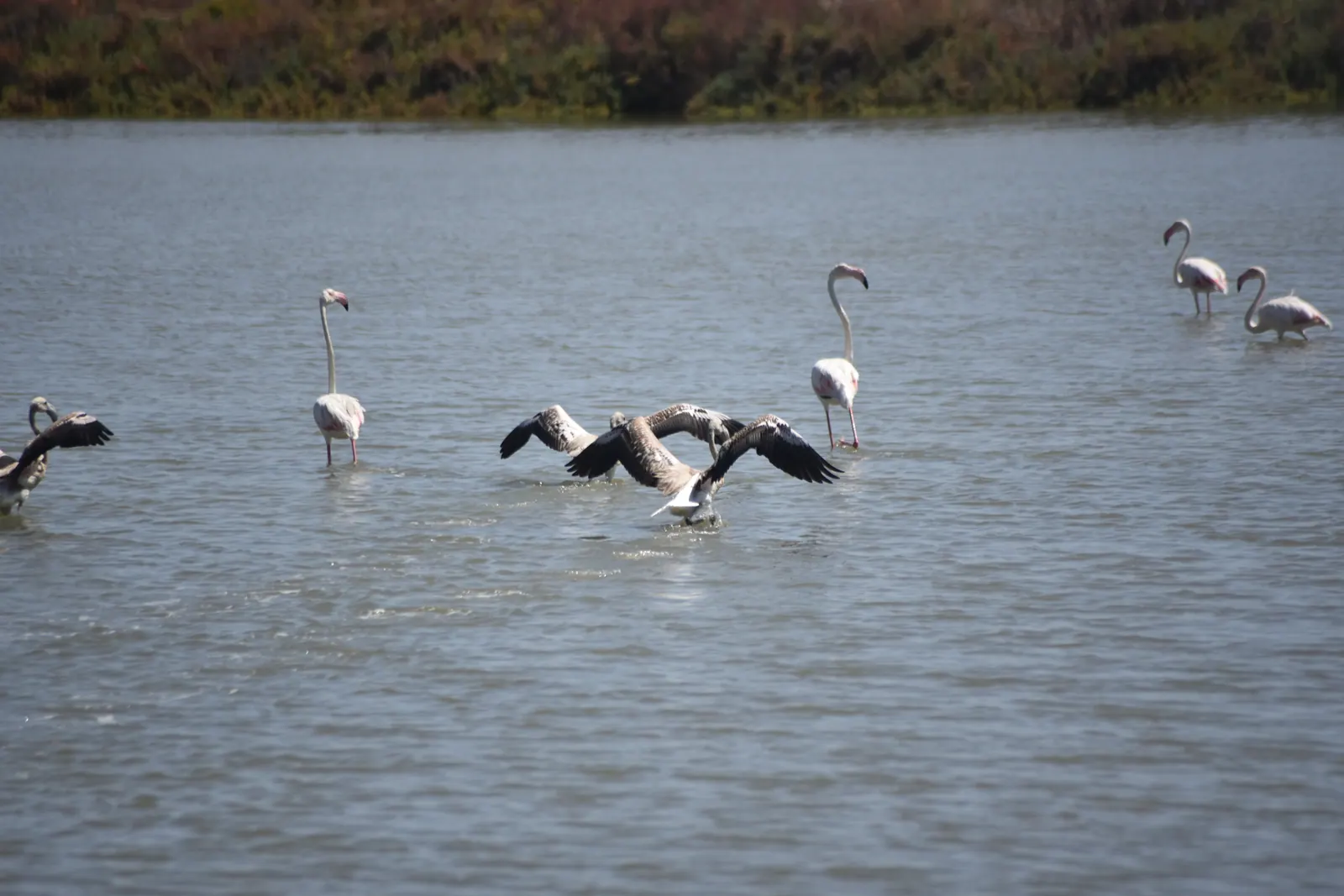
- Salt pans: flamingos, avocets, black-winged stilts and Kentish plovers, plus salt-loving plants along the banks.
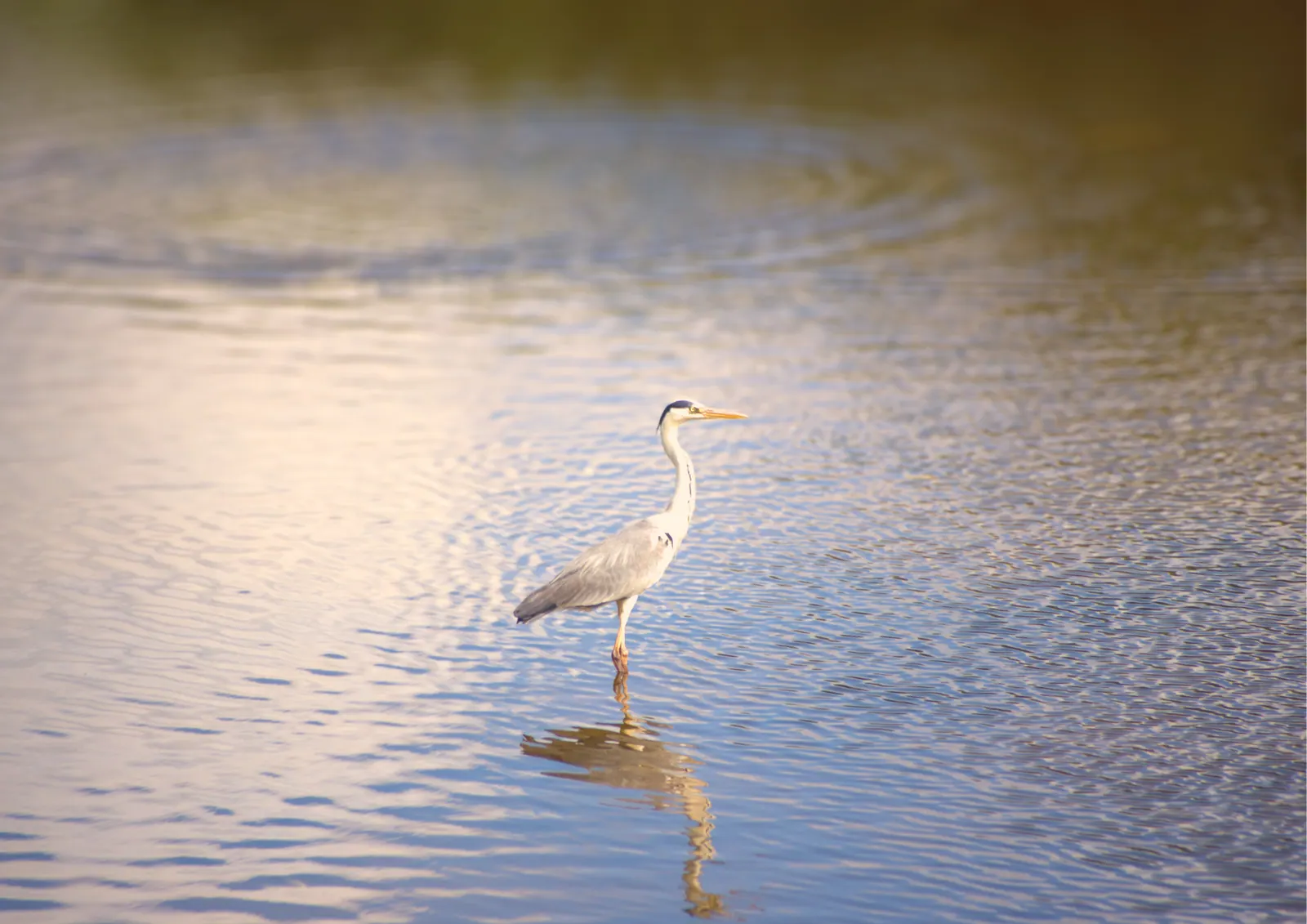
- The lagoon and the mudflats: waders such as redshank, grey plover, dunlin, sanderling and oystercatcher, little egrets and grey herons, depending on the tide.
- Pine woods and scrub: the Iberian magpie and many small birds.
- Freshwater lagoons and reeds: the western swamphen, ducks, grebes, spoonbills and glossy ibis.
- Overhead: white storks, and in winter, ospreys.
For more species and the best seasons, see our guide to birdwatching in the Ria Formosa and our guide to seeing flamingos in the Algarve.
Best time to walk the Ludo Trail
- Time of day: early morning or late afternoon. Birds are more active, and in summer the middle of the day is hot, with little shade.
- Tides: on the lagoon side, a falling or low tide is best for feeding waders; on the inland lagoons, a high or rising tide pushes more birds inland to rest. Because the Ludo includes both, you will always have something to watch, whatever the tide.
- Season: good all year. Spring and autumn bring the most species; winter brings ducks and waders; summer brings breeding birds and good numbers of flamingos.
Tips and rules
- Stay on the marked paths. Parts of the area are closed to protect nesting birds.
- The salt pans are private and working: watch from the paths, never walk on the banks.
- Dogs are allowed on the trail. Keep them on a lead near the birds. Bicycles are allowed too: slow down and watch out for people walking.
- Planes take off and land right next to the trail. The birds are used to them; you will get used to them too.
- Bring water, a hat and sun protection, and binoculars if you have them.
Walking the Ludo with a biologist
You can walk the Ludo on your own. If you would like someone to show you where to look, lend you a telescope and explain the tides, the salt-making and the birds, that is what we do on our Birdwatching & Nature walk in the morning and our Sunset Walk in the late afternoon, in small groups of up to 10 people.
Frequently asked questions
How long is the Ludo Trail?
The route we recommend, combining the Ludo and São Lourenço trails, is about 9 km there and back. You can make it shorter by turning back after the first bird hide.
Is the Ludo Trail free?
Yes. The trail and the bird hides are free and open to everyone.
Where do you park for the Ludo Trail?
In the free car park on the south side of Faro airport.
Can you walk the Ludo Trail with a dog?
Yes, dogs are allowed. Keep them on a lead near the birds.
Can you cycle the Ludo Trail?
Yes, bicycles are allowed. Ride slowly and give way to people walking.
Is the Ludo Trail circular?
No. Parts of the area are closed to protect the birds, so you return the same way.
What birds can you see on the Ludo Trail?
Flamingos, spoonbills, white storks, herons and egrets, waders, the western swamphen and the Iberian magpie, among many others.
Sources and further reading
- Birdingplaces: Caminho do Ludo
- Walk Algarve: Ludo Trail, Ria Formosa birds and nature
- eBird: bird list for the Ludo area
- First Nature: Wildlife of Parque Natural da Ria Formosa
The route, distances and observations in this guide come from our own walks on the Ludo Trail.